
Land

Discussion is held on various techniques of mapping burnt areas from remotely sensed data, describing the main sources of errors and strategies to overcome them.
Discussion is held on various techniques of mapping burnt areas from remotely sensed data, describing the main sources of errors and strategies to overcome them. Focus of first part of this session is so-called Fire Detection and Monitoring (FD&M) product, which provides continuous monitoring of fire activity over Africa and Europe. This product relies on Fire Detection Algorithm called FiDAlgo (based on so-called contextual algorithms), is an operational procedure that allows active fire detection in near-real-time and is based on information from Meteosat-9, i.e. SEVIRI instrument.
The second part will present applications to the analysis of burnt scars and vegetation recovery, with case studies for the Iberian Peninsula. Operational product for tracking burnt areas LSA-SAF still doesn't have, but presentation gives perspective of rising such. Very simple model for post-fire vegetation recovery is presented and are shown correlations between post fire vegetation recovery dynamics and severity of fire damage.
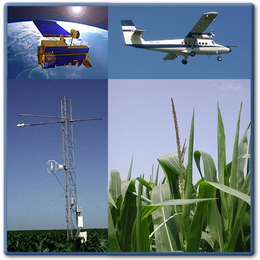
Presentation divided into three parts; general description of LSA SAF; applications of LSA SAF products ; and the way foward, i.e. perspectives of LSA SAF.
This session is a wrap up of all applications of the LSA SAF products, feedback from users (annual revision by technical and scientific review panels), lessons learned and roadmap for the next phase (2012-2017).
The presentation is divided into three parts; general description of LSA SAF; applications of LSA SAF products ; and the way forward, i.e. perspectives of LSA SAF.

Presentation during the event week on Snow in January 2010.
Hannes Rieder from ZAMG, Austria who will provide a presentation on the interesting forecasting challenges associated with avalanches in Styria.

Presentation during the event week on Snow in January 2010.
Niilo Siljamo (FMI, Finland) will introduce the snow cover product (SC) based on MSG/SEVIRI. He will describe the main parts of the algorithm with attention to various cases of snow cover.
In the second part, Nuno Moreira (IM, Portugal) will talk about snow products derived from MSG during the unusual snow events that have occurred in Portugal between November 2008 and February 2009.

Presentation during the event week on Snow in January 2010.
Izolda Marcinoniene will present a case study. According to Lithuanian criteria for meteorological phenomena it was a local-scale catastrophic event that affected the city of Nida, located on Baltic coast. Based upon the physical parameters of the atmosphere and the satellite information obtained, the situation was typical for Comma cloud. The main features and reasons for development of this catastrophic heavy snow event will be presented using detailed information such as vertical cross-sections, tephigrams and various satellite images.
The second talk will be presented by Natasa Strelec Mahovic from the Croatian Meteorological Service (DHMZ). DHMZ will give a presentation on the forecast and analysis of heavy snowfall in Croatia in February 2009, when snow was recorded even on the remote islands in Southern Croatia!

Presentation during the event week on Warning in October 2010.
Presentation by Nuno Moreira (IM) and Andreas Wirth (ZAMG) on the exceptional summer of 2010 when a large scale crest was covering the two countries. As a result of the exceptional high temperatures and extreme low dew-point temperature the conditions were very dry. This resulted in a wide amount of forest fires. Within the high pressure and the lack of a governing flow the smoke caused many problems to Moscow.

Presentation during the event week on Warning in October 2010.
Presentation by the LSA SAF by Carla Barroso on the Fire Radiative Power product which was developed and is used by IM (Portugal) assessing the risk of forest fires.
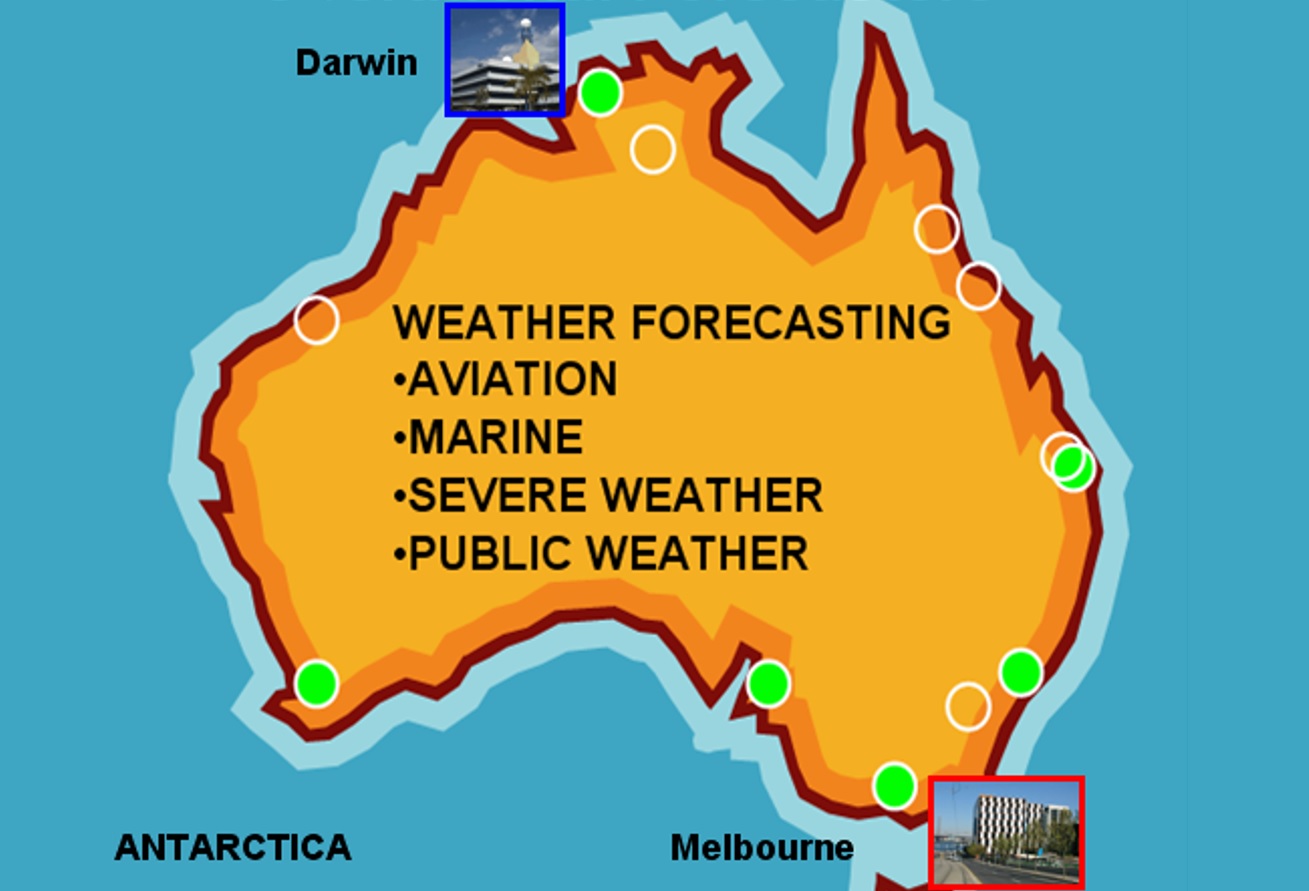
Bodo Zeschke gives a comprehensive overview of the technical facilities available at the Australian Bureau of Meteorology followed by a weather briefing and a short lecture on shallow cold fronts.
Length: 50 min
Author: Bodo Zeschke
Bodo Zeschke received his BS in Physics at the University of New South Wales and MS in Meteorology at Monash University (2001). From 2001 to 2009 he worked as a forecaster at the Darwin Regional Forecasting Centre. During this time Bodo developed an interest in fog and low cloud nowcasting and forecasting for northern Australian regions. Since 2009 he has been engaged as a Lecturer to Australian and International postgraduate students studying for the Diploma of Meteorology at the Bureau of Meteorology Training Centre. Bodo has lectured in Tropical Meteorology, Satellite Meteorology and Weather Discussion training. Duties also include presenting lectures on related topics at World Meteorology Organisation courses and at the Bureau's annual Advanced Forecaster Workshop. He is the point of contact for the Australian VLab Centre of Excellence. Present topic of interest includes the integration of the satellite multichannel RGB products generated from MODIS imagery into Bureau forecast and training resources. This in preparation for the effective use of RGB products generated by the future Himawari 8 satellite.
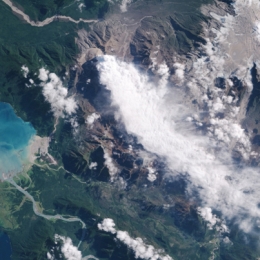
The training module aims at giving an overall view on the use of satellite data, particularly that provided by Meteorological satellites, for monitoring vegetation cover and properties.
The distribution of vegetation, its properties and state, is of major importance for a wide range of applications, namely; environmental management, natural Hazards monitoring, agriculture and forestry, climate change studies and numerical weather forecast models.
Changes in the landcover either caused by changes in land use, climate change or natural hazards (like forest fires or droughts, for instance) may have a huge social and economic impact. An example of this was the severe drought that stroke Eastern Africa in 2009, causing crops to shrink and threatening millions of people with starvation.
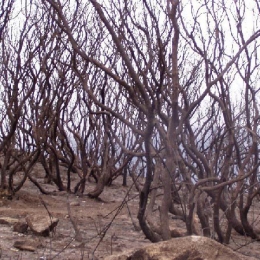
Every summer forest fires make it to the headlines. This training module will explain all the meteorlogical aspects associated to forest fires give you a wide range of products.
The past decade forest fires have received much media attention due to the impact it has in environmental terms. This CAL is mainly for forecasters that deal with forest fires. However, the module may be used by others dealing with forest fires like, civil protection agents, fireman or forecasters.
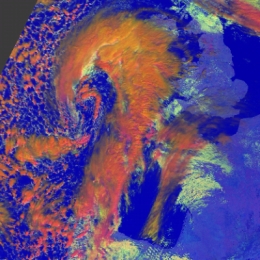
The purpose of this training module is to give an overview on the different RGB types created from the AVHRR instrument.
This training module describes MetOp AVHRR (Advanced Very High Resolution Radiometer) RGB schemes that are based on EUMETSAT recommendations. The 'recipes' were tuned to create high quality MetOp/AVHRR RGB images as similar as possible to the SEVIRI RGB schemes recommended by EUMETSAT.
The main aim of the training module is to help the users (weather forecasters and/or other experts) understand and use these RGB types by giving them background information, examples and exercises.
The module takes the following structure:
- The aim of the RGB type
- Physical background
- How to create the given RGB type
- Typical colors
- Examples of interpretation
- Benefits and limitations
- Comparisons with other RGB types and/or single channel images
- Exercise
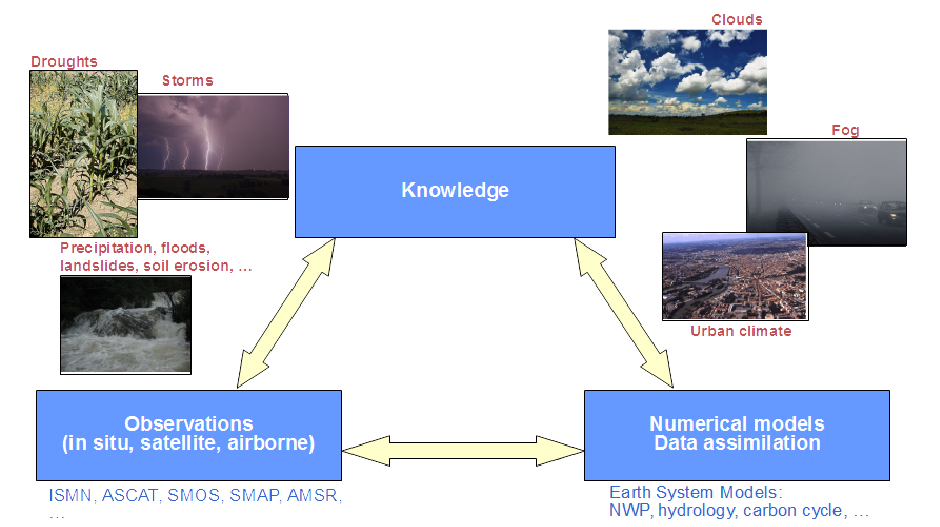
Jean Christophe Calvet talks about the assimilation of H-SAF soil moisture products into models.
Length: 28 minutes.
In situ and satellite-derived soil moisture observations are needed to better understand and simulate land surface processes. This has been the subject of active research for more than two decades. The transfer to operations in weather forecast, hydrometeorological, and drought monitoring applications also implies the integration of satellite-derived observations into models. Examples of the use of soil moisture observations, simulations, and data assimilation are presented.